
IPYNB to MD (Markdown) Converter
Convert any Jupyter Notebook into a clean portable Markdown in seconds. This free online ipynb to markdown converter runs without nbconvert, Pandoc or any local install. Code cells become fenced Markdown blocks. Prose cells stay as readable Markdown text. Upload your .ipynb file, preview and download a ready to publish .md file.
Supports multiple files · Converts to Markdown (Max 20MB each)
Related Converters
How to Convert IPYNB to MD
Finish your ipynb to markdown export in three quick steps. No setup needed.
Upload Your Jupyter Notebook
Drag and drop your .ipynb file into the upload area or click to browse. Run all notebook cells first to include the latest outputs and rendered charts in the Markdown file.
Choose Your Export Options
Pick whether to keep cell outputs, extract images to a folder or use GitHub flavored syntax then click Convert. The tool handles code cells, markdown and inline math automatically.
Preview and Download
Review the generated .md file before saving. Download the finished Markdown ready to drop into a GitHub README, MkDocs site, Docusaurus project or Obsidian vault.
Pro Tips for Better IPYNB to MD Results
- Run every cell in your Jupyter Notebook before uploading. Executed cells give the converter the latest outputs to embed as text blocks or image references.
- If your Markdown will live in a GitHub repository, enable the GitHub flavored option. This adds proper language labels to fenced code blocks so syntax highlighting works on GitHub and GitLab.
Save your notebook from JupyterLab, VS Code or Google Colab before uploading. A fresh save captures the latest markdown edits and code changes correctly.
For notebooks with many charts, choose the extract images option. The converter saves images to a folder and links them from the Markdown file which keeps your .md file lightweight.
- If your target is Obsidian or Notion, check that inline math renders using LaTeX syntax. Both platforms support KaTeX so equations transfer without any manual cleanup.
- Remove any API keys or tokens from code cells before converting. Markdown files often live in public repositories where secrets get exposed by accident.
Why Use This IPYNB to MD Converter
Built for developers documenting projects, technical writers publishing tutorials and teams maintaining knowledge bases. Every conversion produces clean readable Markdown ready for any documentation platform.
No Install or nbconvert Setup
Skip pip install, Pandoc and every Python dependency in between. This converter runs on our servers so your notebook becomes a Markdown file in one upload. It works on Windows, macOS, Linux and Chromebook without touching the command line once.
Perfect for GitHub and GitLab README Files
The output uses GitHub flavored Markdown syntax with proper fenced code blocks and language labels. Your python notebook renders beautifully on GitHub, GitLab and Bitbucket without any manual formatting fixes.
Works with Every Documentation Platform
The clean Markdown output drops straight into MkDocs, Docusaurus, Jekyll, Hugo, Gatsby and VuePress. No syntax cleanup time, no reformatting the file and no any broken code blocks after you import your .py file.
Files Are Deleted After Every Conversion
Each uploaded notebook is processed in an isolated environment then removed from the server the moment your MD (Markdown) file is ready and you save it. Nothing is stored, logged or shared with anyone except you.
Import Ready for Obsidian and Notion
The Markdown output uses standard syntax that Obsidian, Notion, Bear, Logseq and Roam Research all understand. Your notebook becomes a note in your knowledge base without any manual editing.
Responsive on Every DeviceMath Equations Stay Intact
LaTeX math expressions wrapped in single or double dollar signs carry over exactly. KaTeX and MathJax equations render properly wherever the Markdown gets published or imported.
About the Formats
File extension
.ipynb
Category
Document/Office file formats
Developed by
Mime type
application/x-ipynb+json
Format description
IPYNB stands for Interactive Python Notebook, a format created by the IPython Project around 2011 and later adopted across the broader Project Jupyter ecosystem. Each file is a JSON document holding code cells, Markdown text and mathematical equations in one place. Cell outputs sit right below the code that produced them. The format supports Python, R, Julia and JavaScript through kernels which makes it the standard for reproducible research and data science workflows.
File extension
.md
Category
Markup file formats
Developed by
John Gruber, Aaron Swartz and others
Mime type
text/markdown
Format description
MD stands for Markdown, a lightweight markup language created by John Gruber and Aaron Swartz in 2004. It uses simple plain text syntax with symbols like asterisks, underscores and hashes for formatting instead of complex tags. Markdown files render as HTML across GitHub, GitLab, Bitbucket, MkDocs, Docusaurus, Obsidian, Notion and every modern documentation platform. This makes .md the universal format for technical writing, project documentation and version controlled content.
(Markdown)MD to IPYNB Converter
Not every workflow moves in one direction. If you have a Markdown document from a README, blog post or documentation site that needs to become an interactive Jupyter Notebook for teaching or experimentation, our Markdown to IPYNB converter reverses the process. The output opens directly in JupyterLab, VS Code or Google Colab with your content split into runnable cells.
How to Convert IPYNB to MD in Seconds
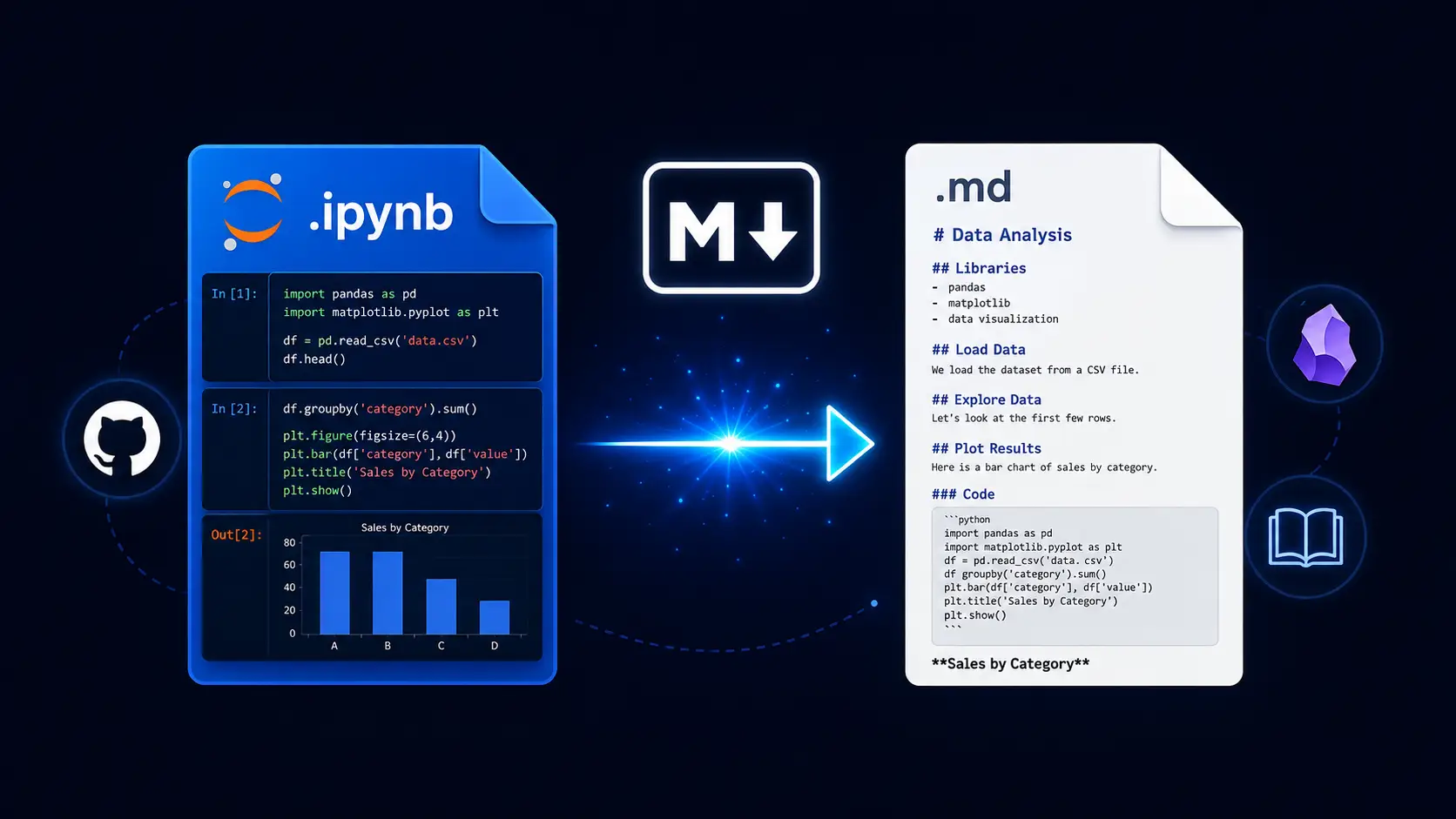
To convert IPYNB to MD (Markdown), upload your Jupyter Notebook file to this tool. Choose whether to keep outputs, extract images to a folder or use GitHub flavored syntax then click Convert. The tool processes your code cells, markdown text and math equations automatically. Chart outputs are preserved as image references. A clean Markdown file is ready in seconds. No nbconvert or Pandoc installation required.
Conclusion
Publishing a notebook as a GitHub README, adding a tutorial to your docs portal or importing analysis into your Obsidian vault all need one thing. Clean portable Markdown that works everywhere. This ipynb to markdown converter gets you there in seconds. No environment setup. No dependency errors. Your notebook reads like a proper document ready for any platform.
FAQs - IPYNB TO MD (MARKDOWN)
How do I convert IPYNB to Markdown online?
To Convert Ipynb to Md, Upload your .ipynb file to the converter, pick your output options then click Convert to download a clean .md file ready to publish.
Do I need nbconvert or Pandoc to convert IPYNB to Markdown?
No. This tool handles the full conversion on our servers so you skip installing Jupyter, nbconvert or Pandoc just to produce a Markdown file.
Will code blocks include language labels for syntax highlighting?
Yes. Fenced code blocks include proper language tags like python, r or julia. GitHub, GitLab and every static site generator render them with correct syntax highlighting.
Will my LaTeX math equations survive the conversion?
Yes. Inline math wrapped in single dollar signs and display math in double dollars carry over exactly. KaTeX and MathJax equations render on GitHub, Obsidian and Notion.
How do I convert IPYNB to Markdown in Google Colab?
Colab has no direct Markdown export option. Download your notebook as .ipynb from File then upload it to this converter for a ready to use .md file in seconds.
Can I use the Markdown output in Obsidian or Notion?
Yes. The output uses standard Markdown syntax that Obsidian, Notion, Bear, Logseq and Roam Research all import without any manual cleanup.
Is my notebook file stored after conversion?
No. Your uploaded file is processed immediately then deleted from the server the moment your Markdown file is ready for download.
Which browsers and devices does this work on?
The converter works on Chrome, Edge, Firefox and Safari. It runs on Windows, macOS, Linux and mobile devices with no plugins required.